

The landscape of product development has shifted. In 2026, the era of the “feature factory” is over. Today, being a product manager (PM) is less about managing a backlog of tickets and more about being the empathetic heartbeat of a business. If you are asking what a product manager does in a company today, the answer lies in the delicate balance between human intuition and data-driven precision, where product manager roles and responsibilities focus on aligning user needs with business goals and delivering measurable outcomes.
A modern product manager job description isn’t just a list of tasks; it’s a mandate to build things that genuinely matter to people.
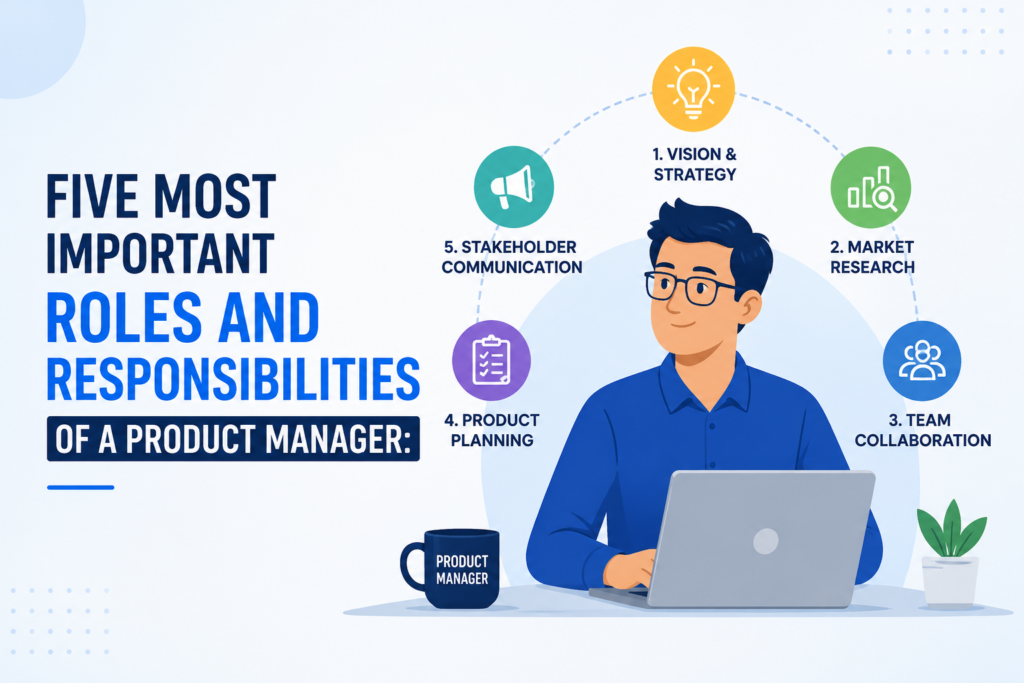
Here are the five most important roles and responsibilities of a product manager:
1. The Visionary Translator
The primary duties of a product manager start with bridge-building. They take a high-level, often abstract business goal and translate it into a concrete, actionable roadmap. In 2026, this means looking beyond the “what” and deeply exploring the “why.” They ensure that every developer, designer, and stakeholder understands the human impact of the code they are writing.
2. The Ethical Data Guardian
With the integration of AI into almost every consumer interface, a critical part of product managers’ roles and responsibilities is now ethical oversight. A PM doesn’t just look at engagement metrics; they ask, “Is this algorithm fair?” Is this feature respecting user privacy?” They act as the product’s moral compass, ensuring that data is used to empower the user rather than to exploit them.
3. The Cross-Functional Glue
If you want to know what does a product manager do in a company day-to-day, they act as the “connective tissue” between departments. They are the only people who speak “engineer,” “designer,” “salesperson,” and “customer” fluently. They facilitate communication to ensure that the vision doesn’t get lost in translation as it moves from the design board to the marketplace.
4. The Value Architect
A standard product manager job description always includes “delivering value,” but in 2026, this means ruthlessly prioritizing. With infinite possibilities provided by modern tech, the PM’s responsibility is to say “no” to 99 good ideas to make room for one great one. They manage the duties of a product manager by focusing on outcomes—like solving a real pain point—rather than just outputs like the number of features launched.
5. The Continuous Learner (The Feedback Loop)
The job doesn’t end at “Launch.” A PM is responsible for the product’s entire lifecycle. They live in the feedback loop, constantly gathering qualitative insights from real humans and quantitative data from analytics. They must be humble enough to admit when a hypothesis is wrong and agile enough to pivot the strategy in real-time.
The Human Edge in Product Leadership
The role of a product manager is inherently human. It’s about empathy for the user, trust with the team, and the courage to lead through uncertainty. While AI can sort data and write documentation, it cannot feel the frustration of a user or the excitement of a breakthrough.
As we navigate the complexities of this decade, the most successful products will be those led by people who prioritize the “human” in “human-computer interaction.” To truly master these product manager roles and responsibilities and lead your team toward meaningful innovation, you need a partner who values the same principles.
ALSO READ: Roles and Responsibilities of Executive Director
Conclusion
This is the philosophy at the core of Florence Fennel. Focusing on the intersection of strategic clarity and human-centric leadership helps organizations refine their approach to product management. With the guidance of Florence Fennel, your product leaders don’t just manage software—they craft experiences that define the future.
Frequently Asked Questions (FAQs)
1. What are the key product manager roles and responsibilities?
Product manager roles and responsibilities include defining product vision, prioritizing features, analyzing user needs, and aligning teams. You ensure the product solves real problems and meets business goals.
2. What does a product manager do in a company?
A product manager connects business, tech, and users. You identify problems, plan solutions, guide development, and track performance after launch.
3. What is a standard product manager job description?
A product manager’s job description covers product planning, roadmap creation, stakeholder management, market research, and performance tracking.
4. What are the main duties of a product manager?
The duties of a product manager include setting priorities, managing the product life cycle, coordinating teams, and improving user experience.
5. What skills are required for product manager roles and responsibilities?
You need strong communication, analytical thinking, leadership, and problem-solving skills. Basic technical knowledge helps you work with developers.
6. How does a product manager differ from a project manager?
A product manager focuses on product strategy and outcomes. A project manager focuses on timelines, budgets, and execution.
7. What does a product manager do daily?
Daily tasks include team meetings, reviewing product metrics, prioritizing backlog, and coordinating with design and development teams.
8. Are product manager roles and responsibilities technical?
Not fully. You don’t need deep coding skills, but you should understand technical concepts to make informed decisions.
9. What industries hire product managers?
Product managers work in tech, e-commerce, fintech, healthcare, SaaS, and many other industries where digital products exist.
10. How do you start a career based on a product manager job description?
Start by learning product fundamentals, gaining experience in related roles, building projects, and understanding user behavior and market needs.