

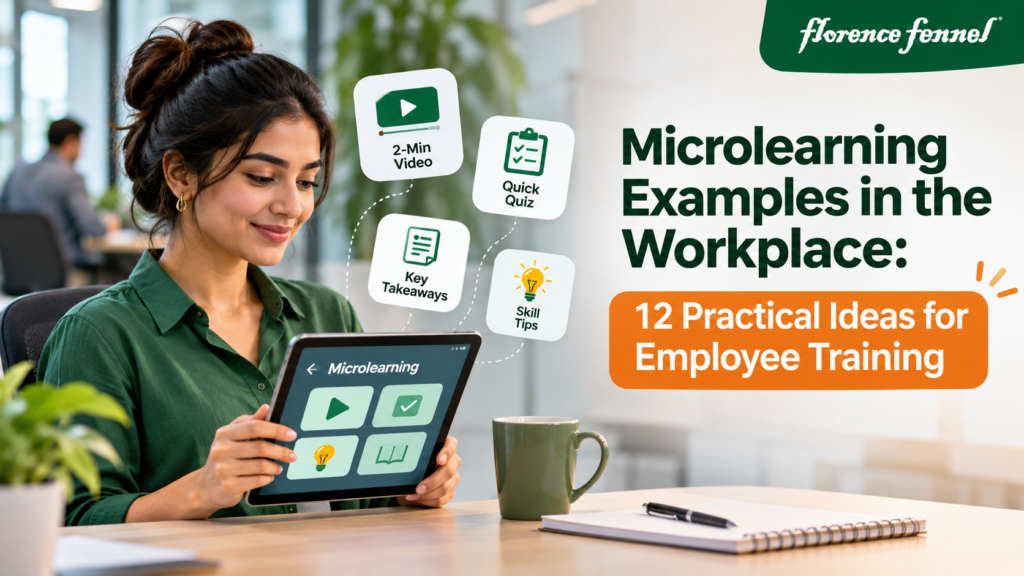
Quick Answer: Microlearning examples in the workplace include short software demonstrations, customer-service scenarios, product flashcards, onboarding tasks and manager coaching exercises. Each module should address one clear objective, include a relevant activity, and explain the answer. Use short lessons alongside practice and follow-up checks, and measure whether employees can apply the skill rather than simply finish the content.
Microlearning for employees works best when the format follows the workplace need. This guide provides examples you can adapt, a sample module storyboard and a practical rollout plan for human resources (HR) and learning and development (L&D) teams in India.
What is microlearning in corporate training?
Microlearning in corporate training means designing small learning units around a focused objective. A unit might teach one procedure, let employees practise one decision or reinforce something introduced in a longer programme.
It is more useful to define the outcome than prescribe a universal duration. A short video explaining an entire company policy may still cover too much. A focused activity that teaches employees how to find the correct policy section has a clearer purpose.
Research uses varying definitions. A 2019 scoping review of microlearning in health professions education found different formats and limited evidence about higher-level outcomes. Findings from that setting should not be treated as proof of productivity gains in every workplace. [1]
What are practical microlearning examples in the workplace?
Useful examples connect a specific employee task with instruction, practice and evidence of application. The twelve ideas below are hypothetical designs, not Florence Fennel client case studies. All suggested durations are planning estimates that should be checked with learners.
How can a short task help new employees find support?
Create a three-minute onboarding activity in which a new employee matches common situations to the right support channel. Examples could include requesting software access, reporting an incorrect payslip or locating a leave policy.
After each choice, explain where the approved information lives. Ask the employee to locate one relevant resource independently. Success means finding the current channel and knowing what information to include, rather than remembering every department’s contact details.
How can a screen demonstration teach one CRM task?
Use a brief recording to demonstrate how to update one customer relationship management (CRM) field correctly. Follow it with a sandbox task using fictional customer information.
Ask the learner to select the appropriate status and enter the required note. A reviewer checks accuracy against the task criteria. Display the software version and review date so the module can be updated when the interface changes.
How can a scenario improve customer-service responses?
Present a customer who has contacted the company twice about the same unresolved issue. Offer three possible replies and ask the employee to choose the most appropriate response under the company’s process.
Explain why the preferred reply acknowledges the issue and confirms the next step without making an unauthorised promise. Follow with a short role-play. Review whether the employee applies the response structure in suitable work situations.
How can product flashcards support sales conversations?
Build a small set of cards around one product’s customer use cases. Put a buyer question on the front and reveal an approved explanation, supporting detail and relevant limitation on the back.
Ask employees to answer before revealing the card. Then have them explain the product in their own words.
How can a module teach employees to recognise suspicious messages?
Show fictional messages and ask learners to identify warning signs and choose the organisation’s approved reporting route. Explain the reasoning after each decision.
Keep examples current and use the security team’s review process. Check whether employees can find and use the reporting mechanism. A quiz answer is only one piece of evidence; it does not establish that the employee will detect every real threat.
How can managers practise constructive feedback?
Give a manager a short scenario involving an incomplete handover. Ask them to rewrite a vague criticism into a statement describing the observed action, its effect and a question inviting the employee’s perspective.
Provide an example response and explain what makes it specific. Pair the module with a coached conversation. Assess the quality of the discussion rather than rewarding the manager for copying a script word for word.
How can a spreadsheet exercise improve data quality?
Provide a fictional spreadsheet containing duplicate records and inconsistent date formats. Teach one approved check, then ask the learner to apply it to a similar sample.
Compare the cleaned file with a reference and ask the employee to explain their decisions. Use approved data and preserve the original.
How can a short audio lesson support meeting preparation?
Use an audio clip to model a concise project update that explains progress, a blocker and the decision needed. Supply a transcript and ask the employee to prepare an update for a fictional project.
Assess clarity using a short checklist. Audio can suit content that does not depend on visual detail, but employees should have a quiet, appropriate opportunity to listen. Avoid making training dependent on commuting or personal device use.
How can an expense scenario explain company policy?
Give employees a fictional expense claim and ask which supporting information is missing under the current company policy. Show the correct evidence requirements after their answer.
Link directly to the approved policy rather than copying extensive rules into the module. Ask employees to locate the relevant section. Measure whether they can prepare a complete example claim, and assign an owner to update the activity when requirements change.
How can a visual activity reinforce a workplace procedure?
Use an approved image to ask trained employees to identify a missing step in a familiar procedure. Explain the answer using the organisation’s current instructions.
Follow up through the responsible supervisor’s established process. For safety-critical work, this activity should reinforce required instruction and supervised competence checks. A short learning interaction should not be treated as permission to perform an unfamiliar task independently.
How can a scenario improve shift handovers?
Present a fictional handover note that omits an unresolved issue and the next owner. Ask employees to rewrite it using the team’s approved structure.
Show a completed example, then review suitable handovers after the training. Check for required information and clarity about ownership.
How can a decision card support responsible AI use?
Present a situation where an employee wants to paste a customer document into an AI tool. Ask what they should check before proceeding under the company’s approved-use policy.
Explain the importance of tool approval, permitted data and review of outputs. Ask the learner to find the current internal guidance. Assess the decision and reasoning rather than suggesting that a general prompt can replace the organisation’s controls.
Which microlearning format should you choose?
Choose the format that lets employees practise the intended task. A video, quiz or flashcard is a delivery choice; the workplace objective determines whether it is useful.
| Learning need | Suitable format | Application check |
| Follow a software step. | Screen demonstration and sandbox task | Correct task completion |
| Make a judgement. | Scenario with explained choices | Reasoning in a new scenario |
| Recall approved product information | Question-first flashcards | Accurate explanation without prompts |
| Prepare a conversation | Example and short role-play | Observed conversation quality |
| Locate a policy | Guided search task | Finding the current approved source |
What should effective microlearning modules include?
Effective microlearning modules connect a clear objective with an example, an employee response and useful feedback. The following original storyboard shows how to build one module around a specific decision.
Illustrative module: Confirming the next step after a customer enquiry.
|
Module stage |
Sample content |
| Objective | Write a follow-up message with a clear action, owner and agreed timing. |
| Situation | A customer requests an update, but a colleague must verify the information. |
| Explanation | Describe what can be confirmed now and what still needs checking. |
| Practice | Rewrite a vague promise into a specific, accurate response. |
| Feedback | Explain whether the response identifies ownership and avoids an unsupported commitment. |
| Workplace follow-up | Review a suitable message with the manager using the same criteria. |
Estimate the learning time after testing the complete activity, including reading and answering. Do not calculate duration from video length alone. Keep feedback available after an incorrect answer and give employees another opportunity to practise.
Florence Fennel’s training content development services provide a relevant starting point for discussing audience needs, practical scenarios and learning objectives.
How can you build a five-day microlearning sequence?
Use a short sequence to revisit a focused skill through varied practice. The schedule below is an illustrative pilot for customer follow-up messages, not a scientifically optimal spacing formula.
|
Day |
Activity |
Evidence to collect |
| Monday | Review a model message and identify its key elements | Initial response to a short scenario |
| Tuesday | Recall the elements before viewing the explanation | Accuracy and reasons for errors |
| Wednesday | Rewrite a different fictional message | Quality against agreed criteria |
| Thursday | Apply the structure to a suitable work task | Manager feedback on application |
| Friday | Complete a new scenario and reflect on remaining difficulties | Progress and next practice need |
Schedule a later check to see whether the skill is retained and used. Adjust the interval to the task and opportunities for practice.
In an educational experiment, Karpicke and Blunt found benefits from practising retrieval compared with the concept-mapping study activity they tested. [2] This supports asking learners to recall and use information. It does not establish that this particular workplace schedule will produce a fixed retention improvement.
How should you introduce microlearning for employees?
Start with a defined performance need and pilot a small set of modules with the employees who will use them. Agree on manager support and the evidence required before producing a large library.
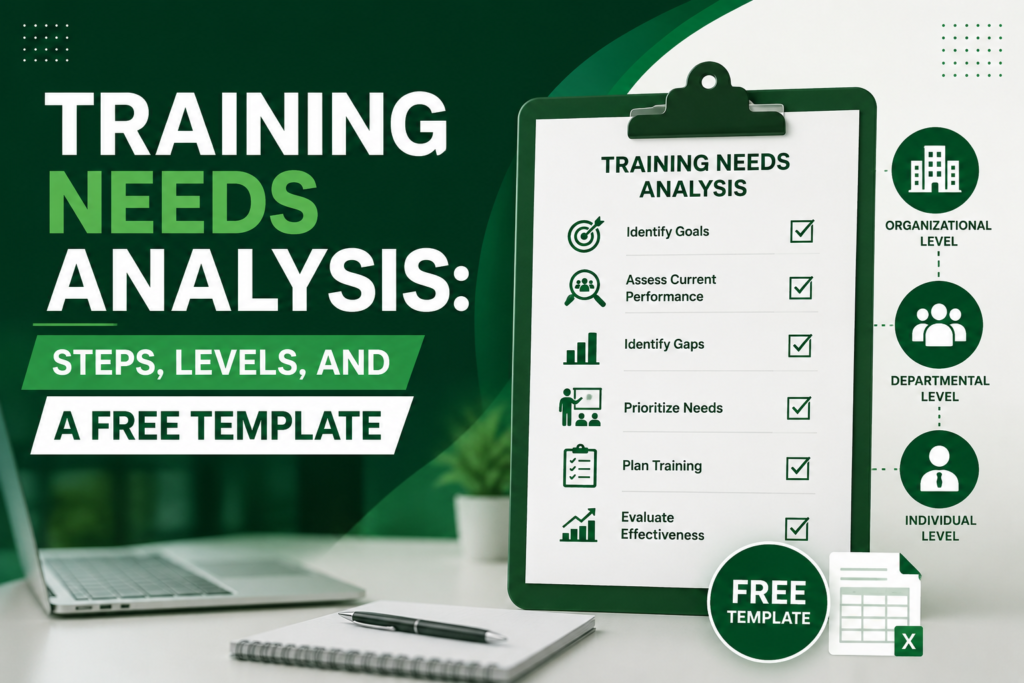
- Confirm the need. Identify a recurring task or decision that employees find difficult. Use a training needs analysis to separate learning gaps from process problems.
- Select one objective. State what employees should be able to do after the activity.
- Build and test. Ask representative users to complete the module and explain confusing points.
- Check access. Provide captions or transcripts, readable text and usable controls. Test the devices and connections employees actually have.
- Arrange practice. Agree when employees can apply the skill and who will give feedback.
- Review and maintain. Assign a content owner, review date and process for removing outdated versions.
For teams across India, check language needs and familiarity with workplace terminology. Translate meaning carefully and test the examples with intended users. Provide learning time within agreed work arrangements instead of assuming everyone can study after hours.
How do you measure whether microlearning works?
Measure learning and workplace application separately from completion. Choose an assessment that matches the objective, then review relevant work samples or observations where appropriate.
For an expense module, check whether employees can identify missing evidence and prepare a complete example. Later, review incomplete submissions using comparable periods and account for policy or system changes.
For a hypothetical pilot, 18 correct responses out of 24 attempts equals 75%. Report the denominator and whether these were first attempts or retries. Repeated attempts and hints can make a completion score look stronger without demonstrating independent performance.
Use delayed questions to check recall and suitable workplace tasks to check transfer. Treat business outcomes cautiously: fewer errors may also reflect improved tools, clearer instructions or changes in workload.
When is microlearning not enough?
Microlearning is insufficient when employees need connected foundational knowledge, extended practice, supervised qualification or complex judgement across many conditions. Use short modules to prepare for or reinforce broader learning where appropriate.
Avoid promising universal retention percentages, productivity gains, or an ideal lesson length. Short content still needs accurate instruction, realistic practice and opportunities to apply it.
How can Florence Fennel support workplace learning?
Explore Florence Fennel’s customised training to discuss relevant learning content, delivery options and how focused activities could support your wider employee development programme.
Frequently asked questions
How long should a microlearning module be?
Keep it short enough to address one objective without unnecessary detail. A few minutes can be a starting design assumption, but test the full activity with learners. Allow enough time for meaningful practice and feedback.
Is a short video automatically microlearning?
No. Length alone does not establish learning value. A video should serve a clear objective and, where appropriate, connect with a task, question or application check. A brief announcement may simply be communication.
Can microlearning replace employee onboarding?
It can support specific onboarding tasks, such as finding resources or using a system. Employees may still need introductions, role clarification, supervised practice and manager conversations. Build short activities into the wider onboarding process.
Do you need a dedicated microlearning platform?
Not necessarily. A small pilot can use approved existing tools that support the activity and required tracking. Check access, version control and feedback before buying another system. A platform cannot compensate for unclear learning objectives.
How often should employees receive modules?
Match the schedule to the learning need, workload and opportunities for application. Start with a manageable pilot and review feedback. Avoid sending daily content simply to maintain a publishing schedule when employees need time to practise.