


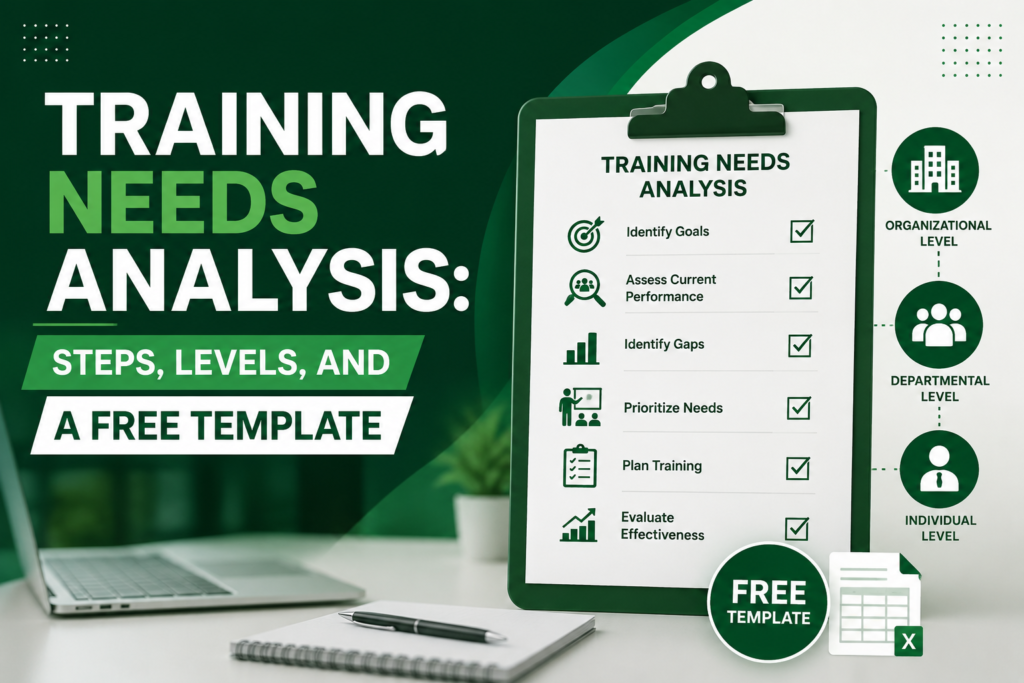
Companies routinely spend on training that changes nothing, because the training was chosen before anyone confirmed what the team actually needed. A training needs analysis fixes that. This guide explains what a TNA is, the three levels it works across, a step-by-step process, sample questionnaire questions, and a template structure you can copy.
What is a training needs analysis?
A training needs analysis (TNA) is the process of identifying the gap between the skills employees currently have and the skills they need to meet performance and business goals. It tells you what training is genuinely required — and, just as importantly, what isn’t — so budget goes to high-impact learning instead of random workshops.
TNA is the first stage of the training cycle. Skipping it is why so much corporate learning fails to move the needle.
Training needs vs performance problems
Not every performance gap is a training gap. If an employee can’t do the task, training may help. If they could but don’t — because of unclear goals, poor tools, or low motivation — training won’t fix it. A good TNA separates skill gaps from process, management, or resourcing problems before recommending any course.
Why is training needs analysis important?
A TNA connects learning to business outcomes. It helps L&D managers and HR teams prioritise the right training instead of wasting time and budget on low-impact courses, and it gives stakeholders a documented reason for every recommended programme. The result is training that targets real gaps, is easier to justify, and can be measured afterwards.
The three levels of training needs analysis
A thorough TNA examines needs at three levels, a structure rooted in the classic McGhee and Thayer model.
| Level | Question it answers | Typical data sources |
| Organisational | Where do our capabilities fall short of business strategy? | Corporate goals, business metrics, strategy documents |
| Job / task | What must someone in this role be able to do? | Job descriptions, task analysis, observation |
| Individual | Where does this person’s performance fall short of the standard? | Appraisals, assessments, manager feedback |
Working across all three prevents a common mistake: training individuals for skills the business doesn’t actually need, or spotting an organisational gap but never translating it into what each role must learn.
How to conduct a training needs analysis
- Define business goals. Start with what the organisation is trying to achieve. Without this, training becomes activity without direction.
- Assess current skills. Gather data on what people can do now using surveys, interviews, performance data, and assessments.
- Identify and prioritise gaps. Compare current skills against what roles and goals require. Rank gaps by business impact and urgency.
- Choose training solutions. Match each priority gap to the right format — instructor-led, e-learning, blended, coaching, or on-the-job practice.
- Deliver, then measure impact. After training, check whether performance actually improved and whether it contributed to the goals set in step one.
Data collection methods for TNA
| Method | Purpose | Best use case |
|
Surveys / questionnaires |
Gather input at scale, quickly | Large teams; baseline self-assessment |
| Interviews | Explore issues in depth |
Managers, key stakeholders, complex roles |
|
Performance data |
Ground findings in facts |
Measurable output — sales, errors, tickets |
|
Observation |
See real on-the-job behaviour | Practical, hands-on roles |
| Skills assessments | Objectively measure capability |
Technical skill validation |
Using more than one method gives a fuller, more reliable picture than relying on any single source.
Training needs analysis questionnaire: sample questions
A short, well-designed questionnaire is often the fastest way to gather baseline data. Sample questions you can adapt:
- Which tasks in your current role do you find most difficult, and why?
- Which skills would help you perform your job more effectively?
- Where do you rely on colleagues because you lack a specific skill?
- What tools or systems do you use that you’d like more training on?
- What has changed in your role in the past year that you feel unprepared for?
- On a scale of 1–5, how confident are you in a specific role-critical skill?
- What training format works best for you — live, self-paced, or blended?
Free training needs analysis template
You can rebuild this as a simple table in a document or spreadsheet:
|
Column |
What to record |
|
Business goal |
The objective the training supports |
|
Role / team |
Who is affected |
|
Required skill |
What the role needs |
|
Current level |
Where they are now |
|
Gap |
The difference |
|
Priority |
High / medium / low by business impact |
|
Recommended training |
Format and content |
| Success measure |
How you’ll know it worked |
Fill one row per priority gap. The completed table becomes both your analysis and your training plan.
Training needs analysis example
Illustrative scenario: A retail company rolls out a new point-of-sale system across stores. An organisational-level look shows the goal is a smooth rollout with minimal downtime. Job-task analysis reveals cashiers, supervisors, and store managers each need different skills. Individual assessments show most cashiers are comfortable with basics but weak on refunds and reporting. The TNA recommends short, role-specific modules focused only on the weak areas — not a generic full-system course for everyone — saving time and budget while targeting the real gaps.
From analysis to action: turning gaps into a training plan
A TNA is only valuable if it leads to a plan. Once your template is filled, group gaps into programmes, sequence them by priority, assign formats and owners, and set the success measures you’ll review later. This is the bridge many organisations miss — the analysis sits in a document while training continues on guesswork.
Build a Future-Ready Workforce With Florence Fennel
Florence Fennel starts every engagement with consulting and needs analysis, then builds customised training that targets the exact gaps we find together. If you want a structured TNA and a training plan tied to your business goals, talk to our team about a needs assessment or explore content development for tailored learning.
Frequently asked questions
What is a training needs analysis?
It’s the process of identifying the gap between employees’ current and required skills, so training targets real needs rather than assumptions.
What are the three levels of training needs analysis?
Organisational, job/task, and individual. Together they align business strategy, role requirements, and individual performance.
Who conducts a training needs analysis?
Usually HR or L&D teams, often with input from line managers and, for specialist skills, external training partners.
When should you conduct a TNA?
Before designing any major training programme, and whenever roles, tools, strategy, or performance signals change significantly.
What is the difference between a TNA and a skills gap analysis?
A skills gap analysis identifies missing skills. A TNA is broader — it also confirms whether training is the right solution and specifies what training to deliver.
How do you measure if a TNA worked?
Compare post-training performance against the baseline and business goals set at the start, using the success measures defined in your template.