

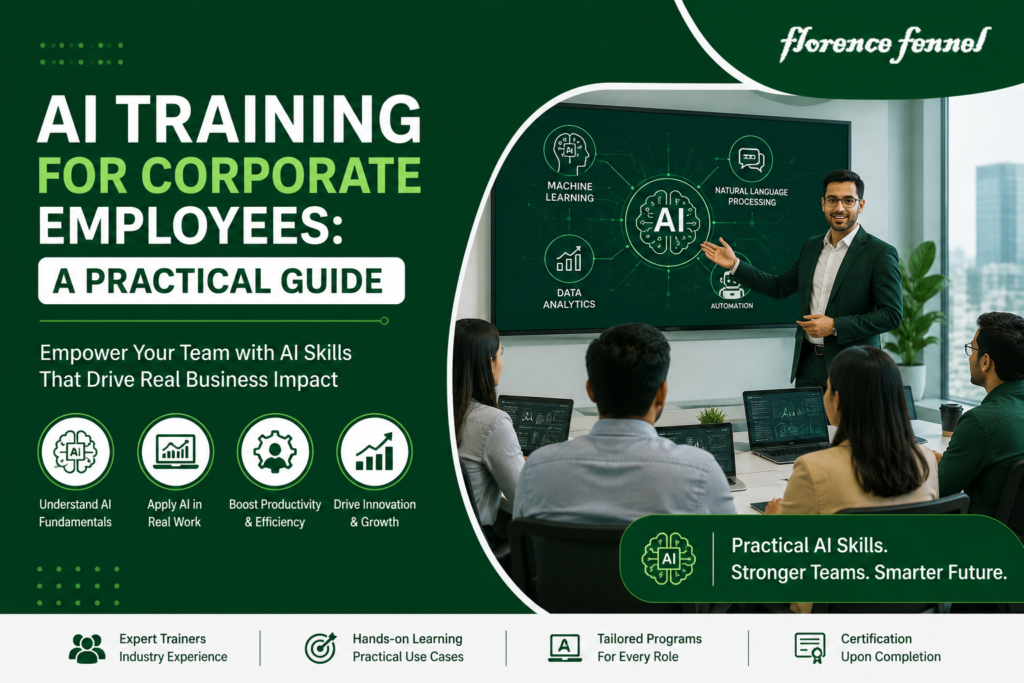
Most companies now say they offer some form of AI training, yet a majority still admit they have a real AI skills gap. That gap isn’t about access to tools. It’s about how the training is built and delivered. Good AI training for corporate employees turns curious but untrained staff into people who can use AI tools safely and confidently in their daily work. This guide covers why it matters, how to build a program, the formats worth considering, and the mistakes that quietly sink most training rollouts.
Why AI Training for Corporate Employees Matters
Business leaders now rank AI and automation as the top skill gap affecting their hiring and planning. At the same time, research shows employees who receive structured training reach far higher proficiency than those left to figure tools out alone.
The upside for companies that get this right is significant:
- Faster adoption of AI tools across teams, not just in IT
- Fewer costly mistakes from employees using AI without understanding its limits
- Better decision-making, since staff know when to trust AI output and when to double-check it
- A stronger competitive position, as AI-literate teams execute projects faster
- Higher employee confidence and morale around using new technology
The gap between companies that train well and those that don’t is widening. Organizations with structured programs tend to adopt new AI capabilities faster and see stronger returns than those leaving employees to self-teach, according to recent industry research.
Employee AI Training: What Good Programs Include
Strong employee AI training usually covers three layers, rather than a single generic course. Programs that stop at layer one often produce employees who can explain AI in theory but freeze up the first time they need to use it under a deadline.
- Foundational AI literacy. What AI actually is, how it works at a basic level, and its common limits, including bias and inaccurate output.
- Tool-specific training. Hands-on practice with the actual AI tools employees will use, tied to their real job tasks.
- Governance and ethics. Company policy on data privacy, acceptable use, and when human review is required before AI output goes out the door.
Skipping any one of these layers tends to produce shallow adoption, where people either avoid the tools or use them carelessly. The strongest programs treat all three layers as connected, not separate courses, so employees understand not just how to use a tool but when it’s the right tool for the job.
How to Build a Corporate AI Training Program: Step-by-Step
- Assess current AI skill levels. Run a short survey or skills check to see where your teams stand today. This also gives you a baseline to measure progress against later.
- Set clear, role-based goals. Marketing, finance, and engineering all need different AI skills. Avoid one-size-fits-all training that leaves most employees learning things they’ll never actually use.
- Choose your training format. Mix short live workshops with self-paced modules so people can learn at their own speed. Busy teams often respond better to shorter, more frequent sessions than one long workshop.
- Build in hands-on practice. Employees should use AI tools on real work tasks during training, not just watch a demo. Practice on real tasks is what actually changes daily behavior.
- Add governance training. Cover data privacy, acceptable use policy, and escalation steps for uncertain AI output. Employees need to know exactly what data they can and can’t put into an AI tool.
- Measure results. Track usage, confidence surveys, and business outcomes, not just course completion rates. A high completion rate means little if nobody actually uses the tools afterward.
- Refresh regularly. AI tools change fast, so plan quarterly updates rather than a single annual session. What counts as best practice today may be outdated within a year.
Getting Leadership on Board
Training sticks better when leaders visibly use AI tools themselves. If managers skip the training or dismiss the tools publicly, employees notice, and adoption stalls no matter how good the course content is.
ALSO READ: Technology Training for Employees
Best AI Training for Employees: Comparing Formats
There’s no single best format for every team. The right mix usually depends on team size, how technical the roles are, and how much time employees can realistically set aside each month.
| Format | Best For | Time Investment | Retention |
|---|---|---|---|
|
Live workshops |
Building confidence, Q&A | Medium | Moderate |
|
Self-paced e-learning |
Flexible, large teams | Low to Medium |
Moderate |
|
Hands-on labs/sandboxes |
Practical skill-building | Medium to High |
High |
|
Role-based coaching |
Senior staff, specialized roles | High |
High |
| Ongoing micro-learning | Reinforcement over time | Low, recurring |
High |
Tips and Best Practices
- Start with a pilot group before rolling training out company-wide.
- Tie training directly to real tasks employees already do, so the value is obvious.
- Give employees safe practice environments, so mistakes during learning don’t create real risk.
- Update materials often. AI training for business professionals goes stale faster than most corporate training.
- Consider a platform like Florence Fennel to track who’s completed training and where skill gaps remain, all in one place.
- Build a simple internal FAQ or channel where employees can ask questions after the formal training ends, since most real learning happens on the job.
Common Mistakes to Avoid
- Treating AI training as a single onboarding session instead of an ongoing program.
- Buying a generic course and skipping role-specific customization.
- Ignoring governance and ethics, which raises real compliance risk later.
- Measuring success only by attendance or completion, not actual skill gain.
- Leaving leadership out of the training, which slows adoption from the top down.
- Assuming younger employees don’t need training just because they’re comfortable with technology in general; comfort with apps doesn’t equal AI literacy.
Conclusion
AI training for corporate employees works best when it’s structured, role-specific, and ongoing, not a one-off event. The companies pulling ahead aren’t the ones with access to the best tools; they’re the ones that taught their people to use those tools well. Assess where your team stands today, build a program around real tasks, and revisit it every quarter as tools evolve.
Ready to close your team’s AI skills gap? Start with a short skills assessment this month, and build your training plan around what you actually find, not around assumptions. Partner with Florence Fennel to deliver practical, role-based AI training that helps your employees apply AI confidently in their daily work.