


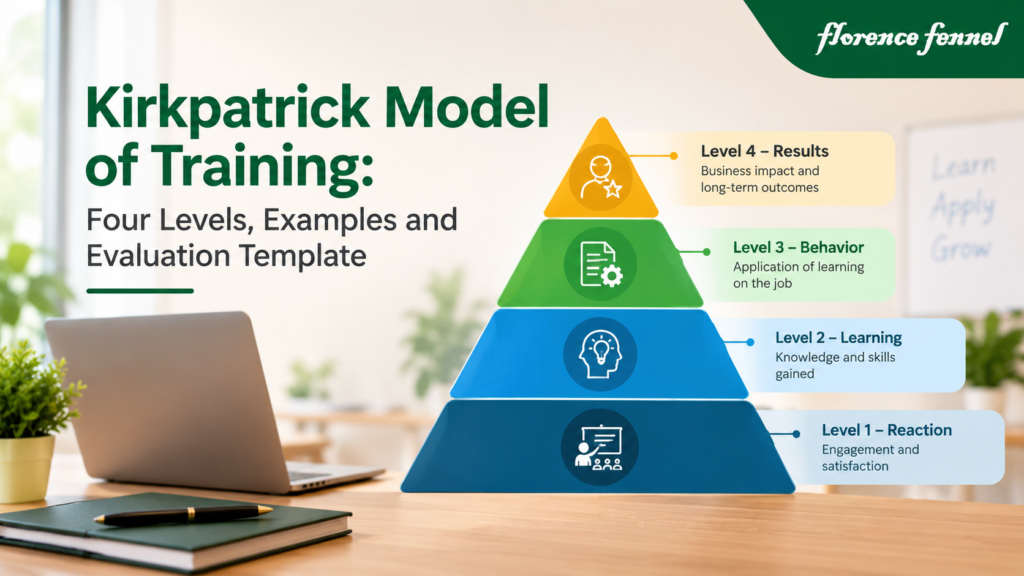
Quick Answer: The Kirkpatrick model of training evaluates learning initiatives through four levels: Reaction, Learning, Behaviour and Results. It examines learner experience, acquired capability, workplace application and organisational outcomes. Plan backwards from the result you need, define the behaviours and support required, then collect evidence during training and on the job to improve the programme.
A workshop receives excellent feedback, but employees continue working as before. Did the content miss the mark, or did employees lack opportunities to practise? A satisfaction survey alone cannot answer that question.
For human resources (HR) and learning and development (L&D) teams in India, the Kirkpatrick evaluation model connects training decisions with evidence of change.
What is the Kirkpatrick model of training?
The Kirkpatrick model is a framework for evaluating a learning initiative from participant reaction through to organisational results. Its four levels are related evidence categories, not a guarantee that success at one level causes success at the next. Kirkpatrick Partners describes the framework as non-linear and cyclical.
That distinction matters when reporting performance. Employees may perform well in an assessment but lack the tools to apply their skills. A business metric may improve because of staffing or process changes alongside training. Evaluation should investigate those possibilities.
What are the four levels of learning evaluation?
The four levels of learning evaluation are Reaction, Learning, Behaviour and Results. Each answers a different question about a programme’s effectiveness. The framework’s definitions are set out by Kirkpatrick Partners. [2]
| Level | Main question |
Illustrative evidence |
|
Reaction |
Is the learning experience useful and relevant? | Relevance feedback and session pulse checks |
|
Learning |
Have participants developed the intended capability? |
Assessments, demonstrations and role-plays |
|
Behaviour |
Are people applying the critical behaviours at work? |
Observed tasks and reviewed work samples |
| Results | Are intended organisational outcomes being achieved? |
Relevant operational and business measures |
Keep these categories separate in reports. Attendance shows participation; it does not establish capability. A test score shows assessment performance; it does not establish routine workplace application.
What does Level 1 Reaction measure?
Reaction examines participants’ experience, particularly whether the programme is relevant and engaging. Collect feedback during delivery as well as afterwards so you can address problems early. This approach is consistent with current official guidance. [1]
For a customer-service workshop, ask learners whether the practice scenarios reflect the enquiries they actually handle. If most examples concern situations outside their authority, revise the activities before the next session.
Suggested questions include:
– Which activity was most relevant to your responsibilities?
– Which part of the session needs a clearer explanation?
– What workplace situation was missing from the examples?
Use a short rating scale with one open response. Record how many people answered and whether feedback covers different roles or shifts. Avoid reporting an average without showing its response base.
What does Level 2 Learning measure?
Learning examines intended knowledge, skills, attitude, confidence and commitment. Official New World guidance includes confidence and commitment alongside knowledge and skill acquisition.
Choose an assessment that matches the task. For SQL training, ask employees to produce and explain a query. For leadership training, assess a feedback conversation against clear criteria. A multiple-choice test can check understanding, but it cannot fully demonstrate either task.
Where feasible, use comparable assessments before and after learning. Keep task difficulty and scoring consistent. If an average rises from 60% to 80%, report a 20-percentage-point increase. State the number assessed and avoid calling it a 20% increase.
Ask about confidence separately from demonstrated ability. Someone can complete a simulation correctly yet feel unable to use the skill with a difficult stakeholder. That response identifies a need for further preparation or support.
What does Level 3 Behaviour measure?
Behaviour examines workplace application and the conditions supporting it. Official guidance emphasises critical behaviours, performance support and accountability, and warns against delaying the start of monitoring until 90 days after learning.
Begin observation when employees first have a meaningful opportunity to apply the skill. Continue checking consistency over time.
Replace “communicates better” with an observable action, such as “confirms the customer’s issue and records an agreed next step.” Then define what counts as a suitable opportunity and what evidence the reviewer will collect.
For each observation, record whether the action was demonstrated, partly demonstrated, absent or not observable. Keep “not observable” separate: employees should not receive a failure score for situations they never encountered.
What does Level 4 Results measure?
Results examine the intended organisational outcomes connected with an initiative and its support. New World guidance also discusses leading indicators that help connect near-term progress with wider results.
For a service programme, investigate whether fewer cases require avoidable rework and how that supports dependable service delivery. For a reporting programme, examine reporting accuracy and turnaround alongside the organisation’s need for timely decisions.
Separate behaviour from outcome. Using the approved checklist is a behaviour; a lower rework rate is an operational outcome. The two may be related, but recording the first does not prove the second.
Agree on metric definitions with the business owner. Compare equivalent periods, report volumes and note changes in staffing, tools or customer mix. Describe training’s contribution cautiously when other explanations remain plausible.
How do you apply the Kirkpatrick evaluation model?
Plan the evaluation before delivery, starting with the desired result and working backwards. Official guidance recommends building evaluation alongside the programme rather than adding it afterwards.
Use this practical sequence:
- Agree the result. Ask the sponsor which organisational outcome the initiative should support and why it matters.
- Check the problem. Establish whether capability is missing or whether unclear processes and unavailable resources are blocking performance.
- Define critical behaviours. Identify the few workplace actions that could contribute to the result.
- Design learning and practice. Teach those actions and assess them with suitable tasks.
- Arrange support. Confirm who will provide coaching, access, reminders and feedback.
- Collect and review evidence. Schedule checks, investigate gaps and adjust the programme or work environment.
Florence Fennel’s training needs analysis guide can help establish whether training addresses the underlying need before the evaluation plan is finalised.
What does a worked Kirkpatrick example look like?
Consider a hypothetical customer-support team learning to diagnose common account problems. The sponsor wants fewer avoidable repeat contacts while maintaining accurate resolutions. The following figures are invented solely to demonstrate evaluation, not Florence Fennel client results.
|
Level |
Evaluation activity | Illustrative finding |
|
Reaction |
Ask whether scenarios match actual enquiries. |
18 of 20 respondents rate the scenarios relevant. |
|
Learning |
Assess diagnosis using equivalent practice cases. |
16 of 20 meet the agreed post-training standard |
|
Behaviour |
Review suitable live cases after training |
Required diagnosis steps appear in 30 of 40 sampled cases |
| Results | Compare repeat-contact rates in matched windows. |
Rate changes from 24% to 18% |
Interpret each finding separately. The relevance result covers respondents, not necessarily everyone trained. The assessment suggests some employees need additional practice. The workplace sample shows application in 75% of reviewed cases; it does not establish the rate across all employees or cases.
The repeat-contact rate fell by six percentage points. Before attributing that change to training, check whether a product fix, staffing change or different enquiry mix occurred during the same period.
If learning scores are strong but application is inconsistent, review access to guidance and manager feedback. If application improves but repeat contacts remain unchanged, investigate whether the selected behaviours address the real causes of repeat enquiries.
Which training evaluation methods should you use?
When comparing training evaluation methods, Kirkpatrick helps you decide what evidence is needed at each level. The method should match the evaluation question, not simply the data your learning platform happens to collect.
|
Method |
Appropriate use |
Main limitation |
|
Short survey |
Relevance, experience and perceived barriers |
Self-report does not demonstrate competence |
|
Test or practical assessment |
Knowledge and task performance | Assessment conditions may differ from work |
| Structured observation | Application in suitable work situations |
Reviewer judgement requires consistent criteria |
|
Work-sample review |
Quality of actual outputs | Samples may not represent the whole workload |
| Operational trend review | Changes in relevant outcomes |
Other events can affect the same measures |
For important programmes, combine evidence rather than relying on one source. For a small refresher module, keep the evaluation proportionate. Official guidance recommends reserving detailed four-level plans for important initiatives rather than treating every short module as a separate impact study.
What should a Kirkpatrick evaluation template include?
A useful evaluation template records the question, evidence, owner, timing and decision for each level. The original worksheet below is a practical planning aid, not an official Kirkpatrick Partners form.
|
Level |
Evidence to collect |
Owner and timing |
|
Reaction |
Role relevance, unclear content and suggested changes | Facilitator; during learning and at completion |
| Learning | Baseline and final task results using agreed criteria | Assessor; before and after relevant learning |
| Behaviour | Critical actions in suitable workplace opportunities | Line manager; first application and repeat checks |
| Results | Agreed business measures and contextual changes |
Business owner; baseline and comparable follow-up windows |
Add the programme name, audience, intended result, metric definition, baseline, target and data source above this table. Beside each row, record the finding, its limitation and the next action.
Set success criteria before delivery. Document sample selection and who can access the evidence. Use approved systems and avoid collecting unnecessary personal or customer information.
How should you interpret mixed evaluation results?
Mixed results should trigger investigation rather than an automatic pass or fail. The following decision guide offers possible explanations to test, not diagnoses that follow inevitably from the data.
|
Evidence pattern |
What to investigate |
Possible next action |
| Positive reaction, weak learning | Insufficient practice or unsuitable assessment | Revise instruction and reassess the target task |
| Strong learning, weak application | Missing access, coaching or opportunity | Resolve barriers and observe suitable work |
| Application improves, results do not | Wrong behaviour, delayed outcomes or external changes | Recheck assumptions and measurement windows |
| Results improve, application unclear | Other changes may explain the result | Gather more evidence before claiming impact |
Assign an owner to the investigation. A report saying “Level 3 needs improvement” is less useful than a decision to restore system access and review five suitable cases the following week.
Is Kirkpatrick Level 4 the same as training ROI?
No. Level 4 examines organisational outcomes. A financial return-on-investment calculation additionally needs credible monetary benefits and the full relevant costs. Useful outcomes such as better service accuracy do not automatically come with a defensible financial value.
For a separate financial analysis, a basic formula is:
ROI (%) = [(Attributed monetary benefits − total programme costs) ÷ total programme costs] × 100
For illustration, ₹3,00,000 in credible attributed benefits against ₹2,00,000 in programme costs gives a 50% ROI. These are hypothetical figures. Include delivery, employee time and follow-up support where relevant; explain how benefits were attributed and avoid counting the same saving twice.
If monetary attribution is weak, report the observed outcomes and limitations instead of presenting an unsupported ROI percentage.
What are the limitations of the Kirkpatrick model?
The framework organises evaluation, but it does not select valid metrics, remove bias or prove causation for you. Those tasks require careful assessment design, suitable data and business context.
Before-and-after results can reflect changes unrelated to learning. Comparison groups may help, but non-equivalent teams can introduce further bias. Report differences in workload, experience and support where they affect interpretation.
There is also a practical cost to gathering evidence. Choose a manageable set of measures and use existing reports where appropriate. Preserve enough detail to support a decision without creating a reporting process nobody can maintain.
Frequently asked questions
What is the difference between Level 2 and Level 3?
Level 2 checks what participants can demonstrate through learning assessments. Level 3 checks how they apply the relevant behaviours at work. A successful simulation does not establish consistent application under normal job conditions.
When should Level 3 evaluation begin?
Begin when employees have a suitable opportunity to use the skill, then continue at intervals appropriate to the task. Early checks help identify barriers; later checks examine whether application continues. There is no universal three- or six-month waiting period.
Can small businesses use the Kirkpatrick model?
Yes. A small business can start with a brief relevance check, one practical assessment, structured manager observations and an existing operational measure. The quality of the questions matters more than purchasing a new platform.
Does every course need a full four-level evaluation?
Not every standalone module needs a detailed study. Prioritise depth for costly, important or business-critical initiatives. A short module may contribute to a larger programme whose outcomes are evaluated together.
Can Kirkpatrick be used for online training?
Yes. Online delivery can include feedback, demonstrations, workplace assignments and follow-up reviews. Video completion and login records show participation, so combine them with evidence appropriate to the intended skill and business outcome.
How can Florence Fennel support your training plans?
Start with the business problem and agree what employees should do differently before selecting a programme. Use the evaluation findings to improve learning, workplace support and the next training decision.
Explore Florence Fennel’s customised training to discuss your team’s learning needs, relevant practice activities and intended outcomes. Agree the scope of assessments and follow-up support as part of the programme discussion.