

Effective communication is the lifeblood of any successful organization. It’s the invisible thread that connects a brilliant strategy to flawless execution. Yet, in the modern workplace—where we are often buried under a mountain of emails, Slack notifications, and back-to-back video calls—genuine connection can get lost in the noise.
We often assume that because we are “talking,” we are communicating. In reality, true communication requires active listening, empathy, and the ability to decode non-verbal cues. This is why communication skills training activities are so vital. They pull us out of our digital silos and force us to engage with one another as humans.
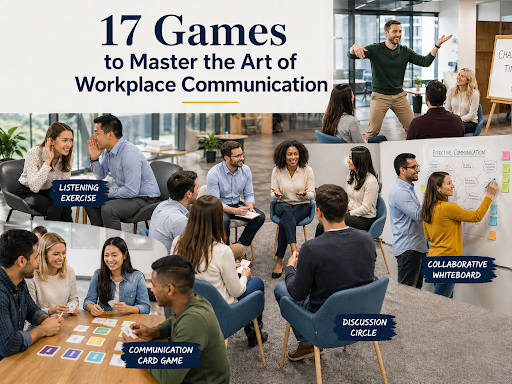
Here is a curated list of the 17 best communication activities for employees designed to break down barriers, build trust, and sharpen the way your team interacts.
The Foundation: Listening and Clarity
1. The Back-to-Back Drawing Challenge
This is a classic for a reason. Two employees sit back-to-back. One is given a geometric shape or a simple drawing, and the other a pen and paper. The first person must describe the drawing without naming it, while the second person tries to replicate it. It’s a humbling lesson in how our “clear instructions” can often be misinterpreted, making it one of the most effective communication activities for employees.
2. 20 Questions (Workplace Edition)
One person thinks of a common office object or a specific workplace challenge. The rest of the team has 20 questions to figure out what it is, but the person can only answer “Yes” or “No.” This game teaches employees how to ask targeted, high-value questions—a skill that is essential for project discovery and client meetings.
3. The “Telephone” Executive Summary
We all played “Telephone” as kids, but the workplace version has a twist. Start with a complex three-sentence business problem. Whisper it to the first person, and let it travel through the team. The final version is usually hilariously different from the start. This exercise highlights how quickly information “decays” and why written follow-ups are crucial in communication exercises for workplace settings.
Building Trust and Empathy
4. Eye Contact Partnering
This might feel a bit “woo-woo” at first, but it is incredibly powerful. Pairs stand and look into each other’s eyes for 60 seconds without speaking. Most of our communication is non-verbal. By stripping away words, employees learn to read the energy and comfort levels of their peers, which is foundational for communication games for teams.
5. The “I Hear You” Circle
In this activity, one person shares a workplace frustration or a personal win for two minutes. The listener cannot interrupt, offer advice, or share their own story. They must simply listen and then paraphrase what they heard: “So, what I’m hearing is that you felt overwhelmed by the deadline because…” This builds the muscle of active listening.
6. Truth and Lies
Everyone shares two true facts about their professional background and one believable lie. The team must discuss and decide which is the lie. Beyond being a great icebreaker, it teaches people to look for subtle cues in body language and tone, making it a staple for team communication exercises.
Problem-Solving and Strategy
7. The Desert Island Priorities
The team is “stranded” and must choose 10 items from a list of 30. The catch? They must reach a unanimous decision. This activity moves beyond simple talking and enters the realm of negotiation and persuasion, showing how different communication styles (assertive vs. collaborative) impact group outcomes.
8. The Silent Square
Divide the team into small groups and give each person pieces of a puzzle. The goal is for everyone to complete their own square. The rule? No talking, no pointing, and you cannot request a piece—you can only give one away. It teaches teams to look for what their colleagues need without being asked.
9. Card Pieces
Give different teams pieces of various playing cards. To complete their sets, they must negotiate and trade with other teams. It’s a fast-paced way to practice “win-win” negotiation, which is a core goal of communication skills training activities.
Creative and Adaptive Communication
10. The Pitch-a-Thon
Give an employee a random, useless object (like a broken stapler). They have 60 seconds to pitch it as a “must-have” luxury item to the group. This builds confidence, quick thinking, and the ability to tailor a message to an audience—the hallmarks of effective communication activities for employees.
11. Misinterpretation Roleplay
Act out a scene where a manager gives a vague instruction and an employee misinterprets it (e.g., “I need that report soon”). The team then discusses how the “sender” could have been more specific and how the “receiver” could have clarified. This is one of the most practical communication exercises for workplace settings.
12. The Storytelling Chain
One person starts a story with one sentence: “Our company just landed a client on Mars.” Each subsequent person adds a sentence starting with “Fortunately…” or “Unfortunately…” This requires intense focus on what the previous person said to keep the narrative coherent.
Quick-Fire Communication Boosters
13. Zen Counting Activity
The team must count to 20 one by one. If two people speak at the same time, you start over. It teaches the group to sense the “rhythm” of the conversation.
14. Charades Business Communication Game
Act out common workplace hurdles, like “the Wi-Fi is down.” It’s a fun way to emphasize non-verbal cues.
15. The No-Email Hour Challenge
A challenge where the team can only communicate via voice or face-to-face. It highlights how much more nuance we get from vocal tone.
16. Positive Feedback Loop Exercise
Spend five minutes where each person tells the person to their left one thing they appreciate about their communication style.
17. The Vague-to-Vivid Communication Exercise
Take a boring sentence like “We did well this quarter” and have the team rewrite it to be as vivid and descriptive as possible.
Why This Matters: Moving Beyond the “Game”
When you implement communication games for teams, you aren’t just filling time. You are building a culture where people feel safe to speak up, where clarity is valued over volume, and where listening is respected as much as speaking.
The result? Projects move faster. Conflicts are resolved before they escalate. Most importantly, your employees feel seen and heard. In the “humanized” workplace of 2026, the companies that thrive are the ones that treat communication not as a soft skill, but as a core operational requirement.
To truly transform the way your organization speaks and listens, you need a partner who understands that every team has its own unique “dialect.” Navigating the complexities of human interaction requires a tailored, thoughtful approach. This is exactly where the expertise of Florence Fennel shines. By integrating high-impact communication activities for employees with deep strategic insights, Florence Fennel helps businesses move past the noise and toward genuine, productive connections. With Florence Fennel, your team won’t just be talking—they’ll be truly communicating.
ALSO READ: Roles and Responsibilities of a CEO in Organization