

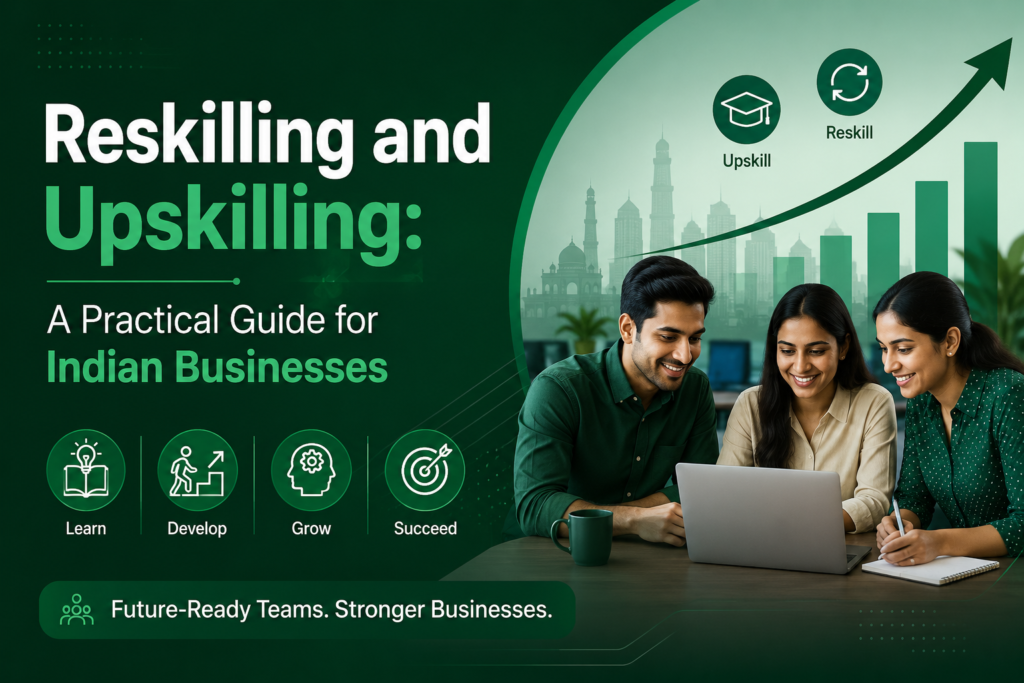
Skills are going stale faster than most companies can hire replacements. A capability that felt current two years ago may already be half-obsolete, and hiring externally for every new gap is slow and expensive. This guide explains reskilling and upskilling in plain terms, shows you how to decide which one a role needs, and walks through building a workforce skilling strategy that actually connects to business results.
What is the difference between reskilling and upskilling?
Upskilling means teaching employees new or deeper skills for the job they already hold. Reskilling means training employees in a different skill set so they can move into a new role. The simplest test: upskilling grows what someone already does; reskilling prepares them to do something different.
Both are workforce development strategies, but they answer different questions and target different people.
What is upskilling?
Upskilling closes the gap between what a role required yesterday and what it demands today. The person keeps their job title and function but gains added capability. A finance executive learning to build automated dashboards, or a support agent learning to work alongside an AI ticketing system, is being upskilled — same seat, expanded ability.
What is reskilling?
Reskilling moves a person sideways into a different role, usually because their current work is shrinking or being automated, or because the business needs their talent elsewhere. An administrative coordinator training to become a junior project manager, or a manual tester learning automation testing, is being reskilled.
Reskilling vs upskilling vs retraining
|
Term |
What it does |
When to use it |
|
Upskilling |
Adds skills to the current role | The job still exists; only the methods are changing |
|
Reskilling |
Prepares for a different role |
The role is shrinking, or talent is needed elsewhere |
| Retraining | Broad umbrella term for teaching any new skill, including refreshers |
Any structured learning intervention |
Why reskilling and upskilling matter for Indian companies
India has one of the world’s youngest workforces, and the pace of change in AI, automation, and the fast-growing Global Capability Centre (GCC) ecosystem is reshaping job roles across IT, BFSI, manufacturing, and services. National industry bodies and global reports (World Economic Forum, NASSCOM) have repeatedly flagged that a large share of India’s workforce will need meaningful reskilling in the coming years — check their latest published reports for current figures, as these numbers are revised regularly.
Two practical pressures make this urgent:
The cost of external hiring. Replacing an employee typically costs several months of salary once you account for recruitment, onboarding, and lost productivity. Building the skill in a person you already employ is usually cheaper and faster, and it keeps institutional knowledge in-house.
Retention. Employees increasingly choose employers who invest in their growth. Learning and development opportunities consistently rank among the strongest retention levers, so a skilling programme is also a talent-retention strategy.
Should you reskill or upskill a role? A quick decision guide
Ask one question about the role: is the work itself stable, or is it disappearing?
- If the work still exists at roughly the same scale and only the tools or methods are changing → upskill.
- If automation is absorbing the work and the headcount for that role is contracting → reskill the person into an adjacent role where demand is growing.
- A useful gut check: if this person left tomorrow, would you backfill the position? If no, that’s a reskilling candidate, not an upskilling one.
Example (illustrative): A mid-sized IT services firm finds its manual QA team is stretched as clients demand faster releases. Testers whose work is stable but tool-driven are upskilled in newer testing frameworks. Two testers whose routine work is being automated are reskilled into automation-testing roles the company is struggling to hire for externally.
How to build a reskilling and upskilling strategy
A programme works when it is tied to business goals rather than run as a set of one-off workshops. Here is a practical sequence.
- Map skills against business goals. Start from where the business is heading — a new product line, a cloud migration, an AI adoption push — and list the capabilities those goals require. Skilling without this anchor becomes random activity.
- Identify and prioritise gaps. Compare required capabilities with current ones using skills audits, appraisals, and manager input. Prioritise gaps that block business goals or carry the highest cost of inaction.
- Design personalised learning paths. People start from different baselines, so a single generic course rarely fits. Blend formats — live instructor-led sessions, self-paced modules, and hands-on projects — matched to each learner’s level and role.
- Validate with certification and real projects. Skills that are never applied fade quickly. Reinforce learning with recognised certifications and, crucially, live or simulated projects so the capability transfers to daily work.
- Track outcomes against business metrics. Measure whether the skilling moved a business number — faster delivery, fewer errors, internal roles filled without external hiring — not just course completion rates.
Common challenges and how to handle them
|
Challenge |
Likely cause |
Recommended response |
|
Low participation |
No time carved out; learning feels like extra work | Ring-fence learning hours; tie skilling to career paths |
|
Skills learned but not used |
No application after training |
Pair training with live projects and follow-up |
|
Hard to prove value |
Only tracking completions |
Link outcomes to business KPIs from the start |
| One-size-fits-all content | Generic off-the-shelf courses |
Customise paths to roles and skill levels |
How to measure the ROI of upskilling programs
Tie every program to a metric you would care about even if training didn’t exist. Strong indicators include internal mobility rate (roles filled from within), reduction in external hiring cost, productivity or quality improvements in the trained team, and retention among participants. Set a baseline before you begin, so the change is measurable rather than anecdotal.
Build a Future-Ready Workforce with Customised Training
Florence Fennel designs customized corporate training that maps directly to your business goals — from AI and data skills to leadership and soft skills — delivered through instructor-led, virtual, and blended formats. If you’re planning a reskilling or upskilling program, explore our Customized Training or talk to our team about an enterprise skilling roadmap.
Frequently asked questions
What is the difference between reskilling and upskilling?
Upskilling adds skills for a person’s current role; reskilling trains them for a different role. Upskilling deepens; reskilling redirects.
Why is reskilling important for companies?
It lets organisations fill emerging skill needs from within — faster and cheaper than external hiring — while retaining experienced people whose current roles are changing.
How do you upskill employees?
Identify the skills your business goals require, assess current gaps, build role-specific learning paths blending live and self-paced training, reinforce with projects, and measure impact against business metrics.
Is upskilling worth it for businesses?
Usually yes. Reskilling or upskilling an existing employee typically costs far less than replacing them, and it improves retention and internal mobility.
Which industries in India need reskilling most?
Sectors facing the fastest automation and AI adoption — IT services, BFSI, manufacturing, and retail — tend to report the greatest urgency.
How long does reskilling take?
It varies by target role and starting point, from a few weeks for adjacent skills to several months for a substantial role change. Personalised paths shorten the timeline.