

Quick Answer
Enterprise AI adoption is the process of integrating artificial intelligence into an organisation’s business processes, workforce, technology systems, products, and decision-making. A successful enterprise AI adoption strategy connects AI use cases to business objectives, establishes governance, prepares employees, evaluates technology requirements, and measures business outcomes.
For 2026, enterprises should move beyond isolated AI experiments and build a structured AI transformation roadmap. This includes identifying high-value use cases, assessing organisational readiness, selecting suitable AI technologies, training employees, establishing responsible AI controls, running pilots, and scaling proven solutions.
Generative AI enterprise adoption in 2026 is increasingly focused on practical business applications such as customer service, software development, knowledge management, marketing, finance, operations, analytics, and workflow automation.
What Is Enterprise AI Adoption?
Enterprise AI adoption refers to the process of implementing and scaling AI technologies across an organisation to improve business processes, employee productivity, customer experiences, products, services, or decision-making.
Enterprise AI adoption typically involves:
- Generative AI
- Machine learning
- Predictive analytics
- AI-powered automation
- AI copilots
- AI agents
- Retrieval-augmented generation
- Intelligent document processing
- AI-powered analytics
- AI-enabled software development
- Enterprise knowledge systems
The key difference between experimenting with AI and enterprise AI adoption is scale.
An employee using a public AI chatbot for a single task is an individual use case. An organisation deploying an approved AI assistant across thousands of employees, integrating it with internal systems, applying security controls, training users, and measuring productivity represents enterprise AI adoption.
Why Enterprise AI Adoption Matters in 2026
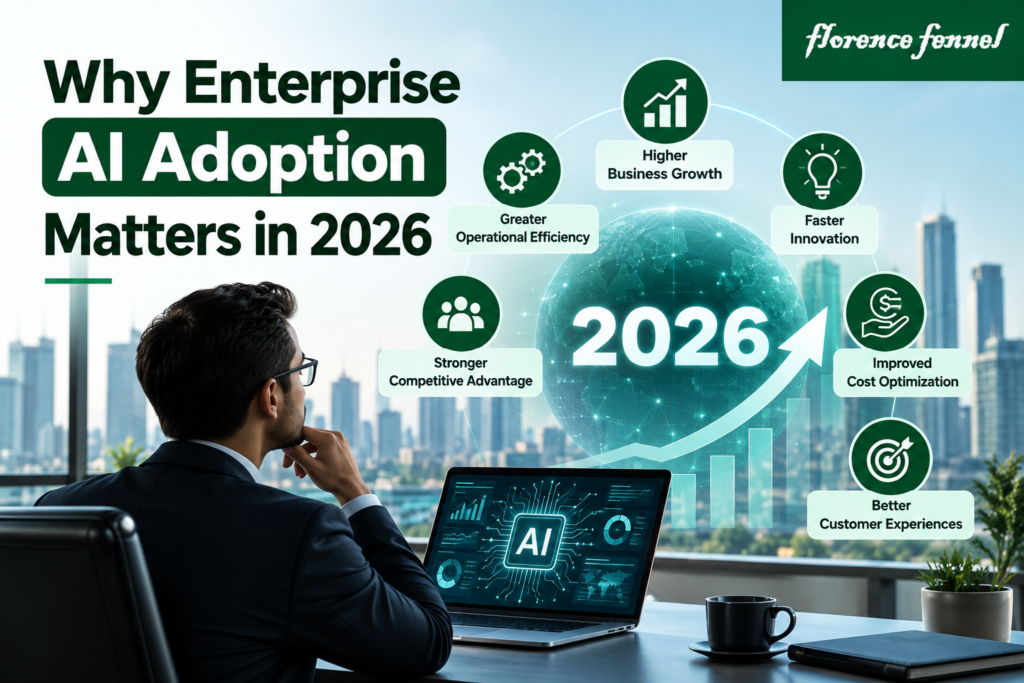
AI adoption is moving from experimentation toward broader organisational implementation.
The World Economic Forum’s Future of Jobs Report 2025 identified AI and information processing technologies as among the major forces expected to transform businesses through 2030. The report also found that 86% of employers surveyed expected AI and information processing technologies to transform their business by 2030.
For enterprises, the key questions are:
- Where should your organisation use AI?
- Which AI use cases create measurable value?
- Which employees need AI skills?
- What data can AI systems access?
- Which AI tools should employees use?
- How should AI systems be governed?
- How do you scale successful pilots?
- How do you measure ROI?
Enterprise AI Strategy: What Should It Include?
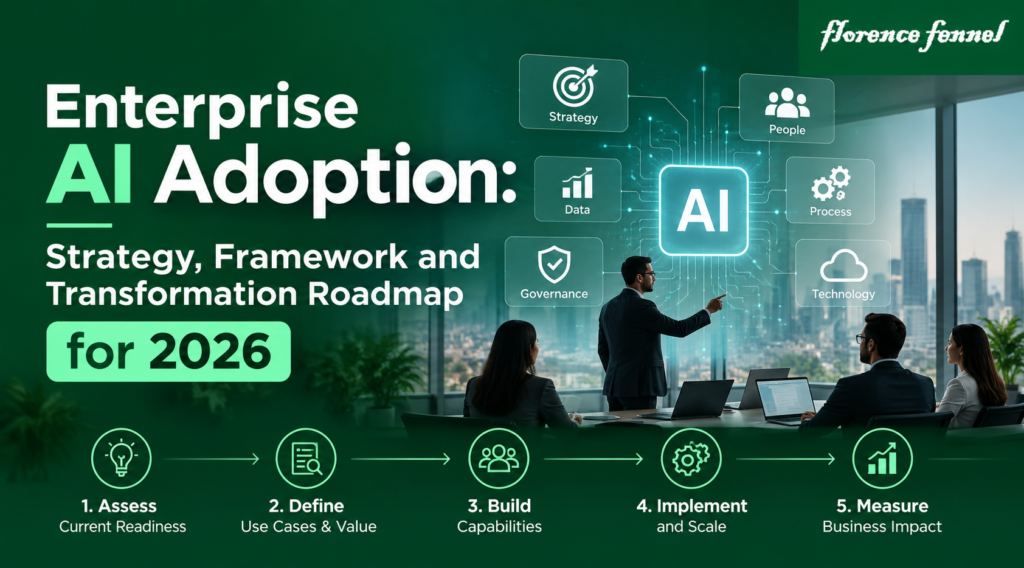
An enterprise AI strategy should connect five areas:
- Business objectives
- AI use cases
- Technology architecture
- Workforce capabilities
- Governance and risk
A useful enterprise AI strategy starts with business priorities rather than technology selection.
For example, a company seeking to reduce customer-service costs might prioritise AI customer-service assistants, knowledge retrieval, automated ticket classification, agent-assist tools, and customer sentiment analysis.
A manufacturing company might prioritise predictive maintenance, quality inspection, demand forecasting, supply-chain optimisation, and production analytics.
The AI strategy should reflect the organisation’s actual operating model.
Enterprise AI Adoption Framework
A practical AI adoption framework can be structured into eight stages.
- Define Business Objectives
Start by identifying measurable business problems.
Ask:
- What business process needs improvement?
- Where are employees spending excessive time?
- Which processes involve repetitive decisions?
- Where do customers experience delays?
- Where does data support better decisions?
- Which workflows have measurable inefficiencies?
Potential objectives include:
- Reduce processing time
- Improve customer experience
- Increase employee productivity
- Reduce operational costs
- Improve forecasting
- Accelerate product development
- Automate repetitive tasks
- Improve decision-making
- Create new AI-enabled products
Avoid selecting AI tools before identifying the problem.
- Assess AI Readiness
Before scaling AI, assess the organisation’s readiness.
Evaluate six areas:
- Strategy: Are AI objectives connected to business goals?
- Data: Is required data available and usable?
- Technology: Can existing systems integrate with AI?
- Workforce: Do employees have required AI skills?
- Governance: Are AI policies and controls established?
- Culture: Are teams prepared to adopt new workflows?
- Identify and Prioritise AI Use Cases
Enterprises often identify dozens or hundreds of potential AI applications. Do not implement all of them simultaneously.
Evaluate use cases based on:
- Business value
- Implementation complexity
- Data availability
- Risk
- Cost
- Time to value
- Employee impact
- Customer impact
- Scalability
The purpose of the framework is to create a consistent evaluation process rather than choosing projects based on hype.
- Build Your AI Transformation Roadmap
An AI transformation roadmap shows how your organisation will move from experimentation to enterprise-scale adoption.
Stage 1: Explore
- AI awareness
- Employee education
- Use-case discovery
- Technology evaluation
- AI policy development
- Initial experimentation
Stage 2: Pilot
- Build prototypes
- Test workflows
- Measure performance
- Evaluate user adoption
- Identify technical limitations
- Assess risk
Stage 3: Scale
- System integration
- Security implementation
- Employee training
- Process redesign
- Monitoring
- Performance measurement
Stage 4: Transform
- AI-enabled workflows
- AI agents
- Enterprise AI platforms
- Continuous employee upskilling
- AI governance
- New AI-enabled products
- Continuous optimisation
Generative AI Enterprise Adoption 2026
Generative AI is one of the major components of enterprise AI adoption in 2026.
Common enterprise applications include:
Customer Service
- Customer query responses
- Agent assistance
- Knowledge retrieval
- Ticket classification
- Conversation summaries
- Customer communication
Marketing
- Content drafts
- Campaign research
- Audience analysis
- Content personalisation
- Market research
- Campaign reporting
Finance
- Report summarisation
- Financial document analysis
- Management reporting
- Variance analysis
- Data interpretation
- Finance workflow assistance
Human Resources
- Job description creation
- Employee communication
- Learning content
- HR knowledge assistants
- Workforce analytics
- Training support
Software Development
- Code generation
- Code explanation
- Documentation
- Test generation
- Debugging assistance
- Software development workflows
Knowledge Management
- Search internal documents
- Summarise policies
- Retrieve information
- Find relevant company knowledge
- Answer internal questions
AI Transformation Strategy: From Tools to Business Processes
An AI transformation strategy should focus on changing workflows rather than simply introducing AI tools.
Traditional workflow:
Data → Manual analysis → Spreadsheet → Report → Review
AI-enabled workflow:
Data → AI-assisted analysis → Automated draft → Human review → Final report
The AI system does not need to replace the entire workflow. Instead, AI can handle selected activities while employees retain responsibility for review, judgment and approval.
How to Build an Enterprise AI Adoption Framework
A practical framework should answer seven questions:
- Why are we adopting AI?
- Where will we use AI?
- Who will use AI?
- What technology do we need?
- What data will AI access?
- What risks need to be controlled?
- How will we measure success?
Enterprise AI Adoption Maturity Model
Level 1: Awareness
Employees are learning about AI through awareness sessions, workshops, demonstrations, and basic AI literacy.
Level 2: Experimentation
Teams test AI through small pilots, individual use cases, generative AI experiments, and productivity testing.
Level 3: Structured Adoption
The organisation establishes approved AI tools, AI policies, training programs, use-case evaluation, and governance processes.
Level 4: Scaled Adoption
AI becomes integrated into multiple business functions through enterprise platforms, system integration, AI-enabled workflows, workforce transformation, and ROI measurement.
Level 5: AI-Enabled Operating Model
AI becomes embedded into business operations through continuous use-case identification, employee training, monitoring, measurement, and governance.
What Are the Biggest Barriers to Enterprise AI Adoption?
Data Challenges
- Fragmented data
- Poor data quality
- Inconsistent formats
- Restricted access
- Outdated information
- Missing documentation
Skills Gaps
Business teams need AI literacy and workflow skills. Technical teams need capabilities such as LLM integration, RAG, AI agents, AI evaluation, AI security, and model deployment.
Governance Challenges
Enterprises need rules for approved AI tools, data access, human review, AI-generated content, security, compliance, model reliability, and monitoring.
Adoption Challenges
Employees might not adopt new systems if training is insufficient, tools are difficult to use, workflows are not redesigned, leadership support is weak, or benefits are unclear.
AI Workforce Transformation and Employee Training
Technology alone does not create enterprise AI adoption. Employees need the skills to use AI effectively.
AI Literacy
- AI fundamentals
- Generative AI
- AI limitations
- Responsible AI
- Prompting
AI Productivity
- AI-assisted research
- Document analysis
- Content creation
- Data analysis
- Workflow automation
AI Practitioner Training
- AI applications
- APIs
- LLMs
- RAG
- AI agents
- AI workflow design
Advanced AI Engineering
- AI architecture
- Agentic AI
- Multi-agent systems
- AI evaluation
- LLMOps
- Security
- Deployment
AI Leadership
- Enterprise AI strategy
- Use-case prioritisation
- AI ROI
- Governance
- Workforce transformation
- Change management
Enterprise AI Adoption Metrics
Adoption Metrics
- Number of active AI users
- Weekly AI usage
- Tool adoption rate
- Number of departments using AI
- Number of approved AI use cases
Productivity Metrics
- Time saved
- Tasks automated
- Processing time
- Output per employee
- Workflow completion time
Quality Metrics
- Error rates
- Review rates
- Customer satisfaction
- Response quality
- AI output acceptance
Business Metrics
- Revenue impact
- Cost reduction
- Customer retention
- Conversion rates
- Operational efficiency
Workforce Metrics
- AI training completion
- Assessment scores
- AI skills improvement
- Employee adoption
- Internal AI project participation
How Much Does Enterprise AI Adoption Cost?
There is no single cost for enterprise AI adoption.
Investment depends on:
- Number of employees
- Number of AI use cases
- AI tools and platforms
- Cloud infrastructure
- Data preparation
- System integration
- Cybersecurity
- Employee training
- Governance
- AI development
- Maintenance
- Monitoring
Before approving investment, build a business case covering initial implementation cost, recurring technology cost, training cost, integration cost, expected operational benefit, risk mitigation cost, and maintenance requirements.
Common Enterprise AI Adoption Mistakes
- Starting with technology
- Running too many disconnected pilots
- Ignoring data
- Treating AI as an IT-only project
- Ignoring employees
- Measuring usage instead of value
Enterprise AI Adoption Checklist
- Is the business problem clearly defined?
- Is there a measurable business objective?
- Is the required data available?
- Has the use case been evaluated for risk?
- Are approved AI tools identified?
- Are security controls established?
- Are employees trained?
- Is human oversight defined?
- Are performance metrics established?
- Is there an owner for the AI initiative?
- Is the solution scalable?
- Is there a process for continuous monitoring?
How Florence Fennel Can Support Enterprise AI Adoption
Florence Fennel provides Customized corporate training programs designed to help organisations build AI capabilities across different employee groups.
Its training areas include:
- AI literacy
- Generative AI
- Agentic AI
- AI-assisted productivity
- AI application development
- Advanced AI technologies
- Corporate AI training
For organisations building AI capabilities across business teams, AI literacy training provides a foundation for understanding AI concepts, applications and responsible use.
Technical teams can follow advanced pathways covering areas such as Agentic AI, AI architecture and enterprise AI implementation.
Enterprise AI Adoption vs AI Transformation
Enterprise AI Adoption:
- Focuses on implementing AI
- Often starts with use cases
- Measures adoption and use
- Can involve individual workflows
- Often progresses incrementally
AI Transformation:
- Focuses on broader organisational change
- Starts with business and operating-model change
- Measures business transformation
- Can change entire processes
- Can involve wider strategic redesign
Enterprise AI adoption can become part of a broader AI transformation strategy.
90-Day Enterprise AI Adoption Roadmap
Days 1-30: Assess
- Define business objectives.
- Assess AI readiness.
- Identify high-value use cases.
- Assess data availability.
- Identify skills gaps.
- Review governance requirements.
Days 31-60: Pilot
- Select priority use cases.
- Build prototypes.
- Train pilot users.
- Establish security controls.
- Measure performance.
- Collect employee feedback.
Days 61-90: Validate and Scale
- Review pilot outcomes.
- Calculate business impact.
- Fix workflow issues.
- Establish production requirements.
- Prepare workforce training.
- Develop the next-stage roadmap.
Final Takeaway
Enterprise AI adoption requires more than purchasing AI tools.
A scalable approach connects:
- Business objectives
- AI use cases
- Data
- Technology
- Workforce skills
- Governance
- Change management
- Business measurement
Your enterprise AI strategy should start with the problems you want to solve.
Your AI transformation roadmap should define how you move from assessment to pilots, from pilots to production, and from individual solutions to scalable AI-enabled workflows.
For 2026, generative AI enterprise adoption is increasingly relevant across business functions, but technology adoption needs to be supported by employee training, governance, data readiness and measurable business objectives.
Florence Fennel can support the workforce capability component through corporate AI training across foundational, productivity-focused and advanced AI learning pathways.
ALSO READ: Prompt Engineering for Business Professionals
Frequently Asked Questions
What is enterprise AI adoption?
Enterprise AI adoption is the process of implementing and scaling artificial intelligence across an organisation’s business processes, workforce, products, technology systems and decision-making.
Why is enterprise AI adoption important in 2026?
Enterprise AI adoption is important because AI is changing business processes, technology requirements and workforce skills. Organisations need structured strategies to identify useful applications, manage risks and develop employee capabilities.
What is an enterprise AI strategy?
An enterprise AI strategy defines how an organisation will use AI to support business objectives. It typically covers use cases, technology, data, workforce capabilities, governance, investment and performance measurement.
What is an AI transformation strategy?
An AI transformation strategy is a broader plan for using AI to change business processes, operating models, employee workflows, products or services. It goes beyond implementing individual AI tools.
What is an AI transformation roadmap?
An AI transformation roadmap describes the stages an organisation follows to move from AI experimentation to scaled implementation and ongoing AI-enabled operations.
What should an AI adoption framework include?
An AI adoption framework should cover business objectives, AI readiness, use-case identification, technology, data, workforce skills, governance, implementation and performance measurement.
What is generative AI enterprise adoption?
Generative AI enterprise adoption is the structured implementation of technologies such as large language models and generative AI applications across business workflows. Examples include AI assistants, content generation, knowledge management, software development and customer-service applications.
How do companies measure AI adoption?
Companies can measure AI adoption through active users, usage frequency, departments using AI, approved use cases, workflow adoption, productivity improvements, quality metrics and business outcomes.
What is the biggest challenge in enterprise AI adoption?
Challenges vary by organisation. Common issues include data quality, skills gaps, security, governance, system integration, employee adoption and difficulty connecting AI projects to measurable business outcomes.
Do employees need AI training for enterprise AI adoption?
Yes. Employees need different levels of training depending on their roles. Most employees need AI literacy and responsible-use training, while technical teams need deeper AI engineering and implementation capabilities.
How long does enterprise AI transformation take?
There is no universal timeline. A pilot might take weeks or months, while broader enterprise transformation typically involves multiple phases over a longer period. The timeline depends on the number of use cases, technology complexity, data readiness, workforce size and governance requirements.