


By the year 2026, the pace of life is accelerating at a fantastic rate, and it is essential for both individuals and companies to continuously update and expand their skills in order to remain competitive. At a time when technology is moving at a fast pace, employment patterns constantly change, and so do the roles workers are expected to fill. In today’s fast-changing world, ongoing learning is not a choice; it is a requirement to stay employable. Having clearly defined key areas of training allows a team to stand firm in the face of uncertainty, to adjust without panicking, and to have a clear idea of what the next step should be.
Considering what is most important for careers in 2026, the key points include professional development training topics, learning paths, and career growth areas, which will influence how people progress in their jobs. When skills are improved through training and courses, the workers gain further expertise. Gradual progress towards improvement is an ongoing process in the workplace through daily training. Every single step takes us further down the road towards our ultimate goals without requiring any exaggerated claims or overly dramatic language.
Professional Development Importance in 2026
When workers can learn new things, their skills are sharpened, their productivity improves, and improvements in output become apparent over time. With every challenge that we face, we become better equipped to deal with the next one. This makes the thought of what is to come seem less daunting.
Professional Development Advantages
- Increased employee engagement and motivation
- Improved productivity and performance
- Stronger leadership pipelines
- Longer stays by clients are recorded. Client satisfaction with the job improves.
18 Professional Development Training Topics Matter for Workforce Growth
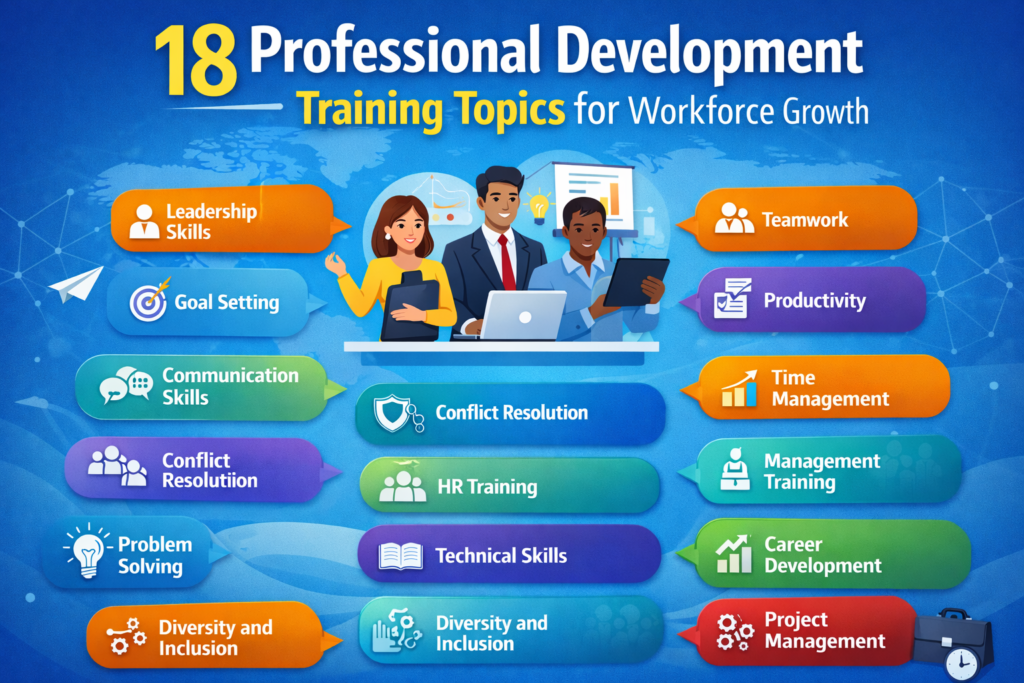
Organizations that equip their workforce with the tools to learn are more likely to have teams that adapt well to changes within the company. While skills are acquired over time, training is most crucial during this process. Continuous learning and striving for knowledge can serve you well when unexpected difficulties arise. It is people’s ability to change over time that gives them strength. The long-term stability of a society is rooted in an ongoing process of learning.
1. Leadership Development
Developing leaders is crucial in any workplace. Many of the obstacles a team encounters can be directly attributed to its leadership.
Key Focus Areas
- Strategic thinking
- Decision-making skills
- Leading diverse and hybrid teams
- Management development initiatives equip workers to handle higher duties.
2. Communication Skills
Clear and precise communication between colleagues is vital in the workplace. What counts most? Being understood without confusion in team settings.
Skills Covered
- Verbal and written communication
- Presentation skills
- Active listening
When people communicate clearly, it is easier to work together. Effective leadership is heightened through the communication process because a message is more readily accepted. Good relations are often fostered when business employees speak clearly to their customers.
3. Emotional Intelligence (EQ)
It is generally not until it becomes quiet at work that individuals become aware of how they handle emotions there. In difficult times, who is listened to is frequently decided by who keeps their emotions under control.
Learning Outcomes
- Self-awareness and empathy
- Managing emotions at work
- Building positive relationships
People who can empathize with team members tend to be more effective at leading teams. It is easier to put differences aside when the way people feel is acknowledged. Working together shifts smoothly under such awareness.
4. Time Management and Productivity
Staying on top of the clock? This problem often proves difficult for many employee development training topics. A lot of control appears to be lost.
Key Topics
- Prioritization techniques
- Goal setting
- Managing distractions
The less stress a person is under, the better they will work in the long term. Daily routines suit more complex tasks.
5. Digital Literacy and Technology Skills
By 2026, virtually every occupation will require some level of IT skills.
Areas of Focus
- Digital tools and platforms
- Data awareness
- Cybersecurity basics
Coming across new equipment in the workplace can be intimidating to some people. The ability to understand digital systems is necessary to keep up with current trends. It is particularly when technology changes rapidly that adaptability skills are crucial.
6. Change Management and Adaptability
Among modern workplace characteristics is constant change.
- Skills Developed
- Managing uncertainty
- Adapting to new systems
- Resilience building
People generally find it easier to change when it is part of a process. Within a firm, a major change usually stems from an internal focus.
7. Critical Thinking and Problem Solving
It’s when we’re facing difficulties that we most need to think clearly. Gradually, one must disassemble these puzzles. People with the ability to stay level-headed are usually better at noticing important details that often go unnoticed by others. A shift in point of view occurs when there is a cumulative effect of several hints.
- Learning Objectives
- Evaluating information
- Decision-making frameworks
- Creative problem-solving
Fresh perspectives on problems bring better ideas into view and promote improvements. When you take the time to carefully consider your approach, you can indeed make better decisions that, in turn, boost your overall performance.
8. Collaboration and Teamwork
Collaboration between people in a business leads to its success.
- Training Focus
- Cross-functional collaboration
- Trust building
- Conflict management
When teams work harmoniously, their productivity increases along with their morale.
9. Diversity, Equity, and Inclusion
In a workplace where everyone feels valued and respected, creativity and innovation are more likely to flourish. The feeling of being part of a group frequently prompts individuals to make more of a greater contribution.
Key Learning Areas
- Unconscious bias awareness
- Inclusive communication
- Respectful workplace practices
- Collaborative teams that are educated on fairness develop good practices. Such an office environment fosters a more welcoming atmosphere.
10. Coaching and Mentoring Skills
Effective coaching helps build lasting organizational capabilities.
Coaching Training Benefits
- Developing others
- Providing constructive feedback
- Encouraging continuous learning
It is a little-known fact that sharing guidance has a strengthening effect on strength. Effective leadership is often developed and perfected in private through mentoring. Everyone leads differently due to their unique personality. Decisions tomorrow are shaped by words today.
11. Stress Management and Wellbeing
The happiness of the staff increases when employers consider their staff’s well-being. The way a team works together on a day-to-day basis often determines what will happen next.
Topics Covered
- Stress management techniques
- Work-life balance
- Mental resilience
When training methodologies that focus on general well-being are used, outcomes are better, and stress is decreased over the long-term.
12. Customer Experience Skills
From all perspectives, customer focus is required.
Focus Areas
- Understanding customer needs
- Handling difficult interactions
- Service excellence
Those businesses that concentrate their message and services tend to elicit a more positive reaction from their clients. Trust grows over time because of this.
13. Negotiation and Influence
Talking through ideas and proposals can help in negotiations, business, and in life.
Learning Objectives
- Persuasive communication
- Conflict resolution
- Win-win negotiation strategies
Teamwork flourishes when individuals work well together. Clear direction allows users to follow instructions with ease.
14. Strategic Thinking
It is easier to see the bigger picture when staff are given the chance to think things through in advance. Generally, what is most important often emerges from consideration of the future.
Key Learning Areas
- Long-term planningBusiness acumen
- Decision-making under uncertainty
- Effective strategic thinking is a vital component in helping the development of leaders.
15. Personal Branding and Professional Presence
In the modern business environment, it pays to be noticed by others.
Topics Included
- Building credibility
- Executive presence
- Career positioning
- Effective use of social networking sites can be an essential tool for an employee’s professional identity.
16. Innovation and Creative Thinking
Innovation brings about new methods of working, which in turn give organisations the edge they need to move forward. It is when creative solutions to current problems are available that growth becomes possible.
- Skills Developed
- Idea generation
- Design thinking
- Continuous improvement
By learning to think in an imaginative way, individuals are able to adapt to new circumstances and tackle problems more efficiently.
17. Ethical Choices and Honesty
No matter how fast the progress may be, there are still certain ethical considerations that stand when it comes to what will truly last.
Learning Focus
- Ethical frameworks
- Responsible decision-making
- Organizational values
People are generally more likely to believe in something when it is presented clearly. The accountability persists when everyone witnesses the outcome.
18. Learning Agility and Ongoing Growth
A rigid refusal to hear anything that might go against what you currently know actually protects you from the possibility of change. The things that truly matter often grow through gradual and unassuming education.
Key Outcomes
- Growth mindset
- Self-directed learning
- Adapting to new roles
Continual learning enables people to carry on with their job. The process naturally allows staff to acquire essential skills as they go through various experiences and challenges in their jobs.
Choosing Professional Development Topics
Selecting the right professional development course topics depends on:
Organizational goals
- Employee skill gaps
- Industry trends
- Career progression paths
- Individuals perform well and can thrive when a balance is struck. Companies, too, will benefit if they manage to advance.
Trends Shaping The Future Of Learning At Work By 2026
- Employee development is shifting toward:
- Personalized learning paths
- Blended and digital learning
- Skills-based development
- Continuous feedback and improvement
When companies respond to what’s coming, their teams get tougher. Many small changes can make it easier for people to adapt to new circumstances. While some businesses are reluctant to adopt the new technology, many eventually make use of it.
Conclusion
Change shapes and careers now. Teams that work together effectively, even through periods of shift, stay strong. True growth is achieved when we can handle the pressures that life brings. When people are allowed to lead and set goals, their confidence tends to increase. Today, the ability to adapt to new conditions is critical. Quiet workers form strong businesses. Not in a hurry.
Companies that work with Florence Fennel have well-designed and long-lasting training sessions. When teams succeed in key areas, the business that backs them also prospers. She establishes educational pathways that are directly related to real-world work. Innovation is driven by the genuine needs of the human population, not by trends. The concept of development should be embedded into work processes, rather than seen as something secondary or ancillary. Every step forward is guided by your long-term objectives.