

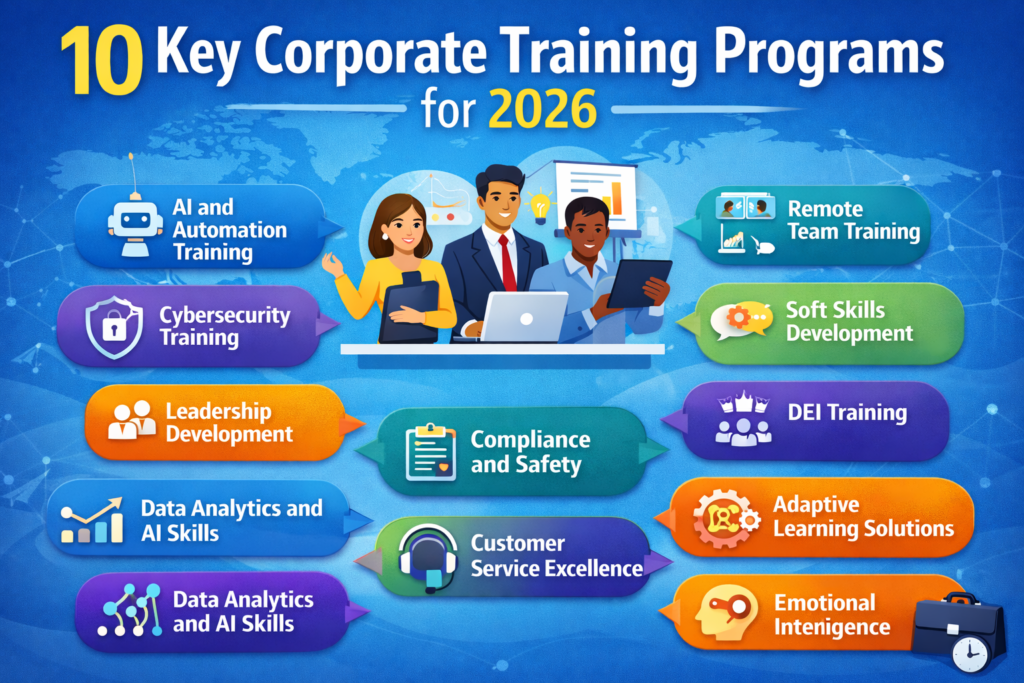
Organizations are increasingly focusing on providing the people who work for them with the training they need to perform their jobs better. By 2026, corporate training programs will be transformed from their current traditional classroom settings into a digital, strategic, and performance-driven process. Companies wishing to keep their position in the market need to have an understanding of the appropriate staff training techniques. Similarly, individuals who wish to advance in their profession must have an awareness of the most appropriate training.
Top training programs for employee initiatives of 2026 focus on the expanding areas of corporate instruction, including digital-based corporate education, and why these kinds of training are crucial for business.
Here Are 10 Corporate Training Programs That Deliver Results
1. Leadership and Management Training
High-priority corporate training programs are usually centered on the key subject of leadership development.
What This Program Focuses On
- Strategic thinking and decision-making
- People management and team motivation
- Emotional intelligence and leadership presence
Why It Matters in 2026
Agile working requires business leaders who can manage, innovate, and lead teams through change in the new workplace. Top-performing companies have developed leadership development as a key strategy to ensure a steady supply of first-rate managers.
2. Corporate Digital Training Programs
Corporate digital training facing changes across every field, businesses now see the need for digital learning at work. A shift like this pushes companies to teach staff new tech skills. Since technology reshapes how things get done, training cannot wait. Workers must understand tools they use daily. Without guidance, confusion grows fast. Learning online helps teams stay capable. When people adapt well, operations run smoother. This kind of growth doesn’t happen by chance.
Key Learning Areas
- Digital tools and platforms
- Data literacy and digital workflows
- Cyber awareness and digital ethics
Business Impact
Workers who understand digital tools get tasks done faster. Change feels easier when tech updates arrive. New ideas spread through teams that know how to use modern systems.
3. Training in communication and interpersonal skills
When people work together, getting messages across clearly really matters.
Core Skills Covered
- Talking and putting thoughts into words on paper
- Presentation and public speaking
- Active listening and conflict resolution
Relevance for Employees
Good talking and listening strengthen bonds with clients, boost how well teams get things done, while also shaping better leaders along the way.
4. Sales and Business Development Training
Putting money into sales training pays off when making more income matters most. A company aiming higher often sees gains from skilled selling. Training sharpens how people talk to buyers. Results grow stronger when teams learn better ways. Success is closely to how well sellers perform daily.
Key Training Areas
- Consultative selling techniques
- Negotiation and closing skills
- Customer relationship management
Top Employee Training Program Explained
Folks who sell things well tend to stick closer to their customers, adapting when those customers want something different. A shifting market doesn’t throw them off – they move right along with it.
5. Training for Better Customer Service
Folks these days expect a lot – more than they used to – from what they buy and how it works. What once seemed fine now falls short without much thought.
Focus Areas
- Customer-centric thinking
- Handling difficult situations
- Service excellence and empathy
Organizational Benefits
When workers really understand how to handle customer interactions, people tend to stick around longer. Because of this, trust grows naturally over time. Fewer frustrations come up when issues get resolved smoothly. Happy experiences spread word about the business without effort. The whole atmosphere at work feels more confident, too
6. Diversity, Equity, and Inclusion Training
Right now, how a workplace treats different people shapes its heart. Quiet moments show who really belongs.
What This Training Covers
- Unconscious bias awareness
- Inclusive leadership practices
- Workplace respect and collaboration
Corporate Training Importance
A fresh mix of voices at work lifts spirits across the group, sparks new ways of thinking, while sharpening how people join forces on tasks. Learning about differences and shared spaces shapes stronger teams over time.
7. Compliance and Ethics Training
Learning about rules helps workers understand duties set by law, ethics, or official standards.
Key Topics
- Workplace ethics
- Data protection and privacy
- Industry-specific regulations
Why It’s Critical
Getting the programme running makes it easier for companies to follow laws, stick to their own rules, and sometimes avoid shady deals. A firm might stay clean simply because the system highlights what’s expected. Rules feel less like guesswork when clear steps are in place. Staying out of trouble becomes routine rather than luck.
8. Emotional Intelligence and Mental Wellbeing Training
Lately, staff wellness has become central to how companies plan their future moves. What matters now shapes what happens next inside many workplaces.
Skills Developed
- Emotional awareness
- Stress management
- Resilience and adaptability
Value to Organizations
Folks who understand their feelings tend to do better on the job, work together more smoothly because they listen closely, while tough moments feel easier to handle when emotions are clear. Success often follows those who stay aware of what others are experiencing, especially under pressure.
9. Time Management and Productivity Training
Facing heavier tasks, such abilities start to matter more. Still, their worth shows most when pressure builds. Rarely do people notice until demands pile up. Then, everything shifts – quietly at first.
Key Learning Outcomes
- Prioritization and goal setting
- Managing distractions
- Work-life balance strategies
Employee Benefits
When workers get what they need to handle their tasks well, stress drops. Better control over daily demands means time and energy for life outside work. Moods lift when people feel balanced. Health often improves alongside job performance. A calmer mind works smarter than one stretched thin.
10. Change Management and Agility Training
Facing shifts head on, companies today find stability hard to pin down.
Focus Areas
- Managing uncertainty
- Adaptability and innovation mindset
- Supporting organizational transformation
Why Important in 2026
When things shift fast – like markets flipping, tech rolling in, or companies reshaping – those who adjust easily keep the wheels turning without jamming. People comfortable with flux help teams move through chaos without tripping over old routines. Flexibility turns pressure into forward motion, quietly smoothing what could become rough patches. Shifts feel less like crashes when some workers treat change as normal weather. A steady hand amid turbulence isn’t loud – it just keeps pace differently.
Common Types of Workplace Training Programs
Most company learning topics by 2026 look like this:
- Leadership and management
- Technical and digital skills
- Behavioral and soft skills
- Compliance and ethics
- Wellbeing and personal effectiveness
Aiming training at clear outcomes brings together pieces that help workers improve while moving the company targets forward. What matters most shows up when effort aligns with purpose, shaping skills alongside results.
The Rising Importance of Company-Led Digital Learning
These days, schools and colleges are using internet classes more than before. Because of this shift, websites that host lessons have grown fast. Workshops happen online now, sometimes mixed with face-to-face sessions. Companies train their staff through digital tools and formats
Scalability across locations
You might find digital tools ready whenever you need them. These options work when it suits your schedule. Some run through the internet so help arrives fast. They respond right away if you ask. Access comes quickly without delays. When you want support, it shows up.
When work shifts online, training must shift too. So flexibility matters more than ever. Because how people learn now isn’t how it used to be. That means old methods fall short. Yet adapting brings smoother sessions. Which helps teams stay on track. Without constant setbacks, progress slows down.
Training Programs Make a Difference
- Companies that prioritize training benefit from:
- Higher employee engagement
- Improved retention rates
- Stronger leadership pipelines
When people pass on what they know, others pick it up naturally. Learning happens more easily when experience moves between team members. New ideas grow where insights are exchanged freely. Work gets done better when skills are spread across a group.
Finding new skills on the job opens doors few expect. Workers start trusting their choices more when learning happens daily. Staying hired longer often follows that quiet confidence.
Conclusion
Change shapes work life by 2026, demanding quick adaptation from everyone on staff. Workers need sharp skills along with a deep awareness of emotions – both theirs and others’. Smart choices in learning paths help companies build groups ready to meet shifts without fear. Success sticks around when effort aligns with growth. Top training picks cover online business lessons, ways to lead better, and more across key fields.
Florence Fennel steps in when companies need training that ties learning directly to where they’re headed. Staff grow skills, while the business moves closer to its targets – no gap left behind. What happens? Training stops being just another task. Instead, it shapes how teams contribute down the line. Goals shift from general ideas to daily actions. Learning fits the path forward, not the past routine. This is how development becomes part of progress.